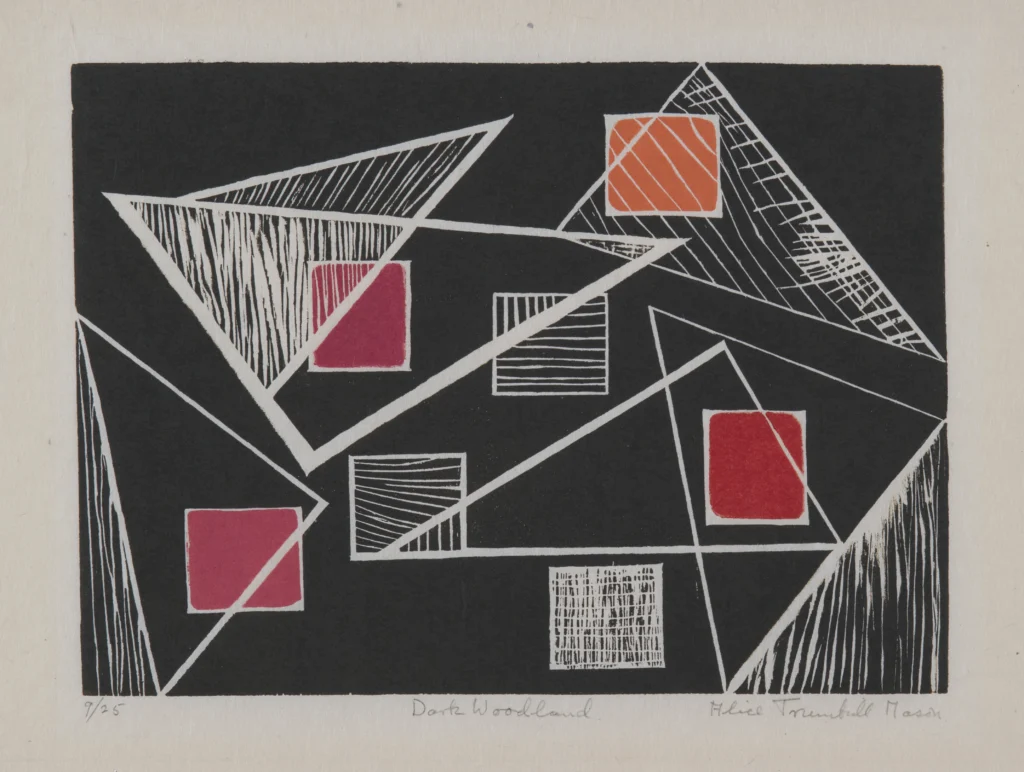
“Mason’s efforts and accomplishments provide a glimpse into the robust network that supported the postwar flowering of abstract printmaking and enabled the approximately sixty women printmakers who worked in Atelier 17’s New York studio to circulate their graphic work across the globe.”
–Christina Weyl, “Networks of Abstraction: Postwar Printmaking and Women Artists of Atelier 17,” Archives of American Art.
A turning point for her artistic practice, Alice Trumbull Mason began creating work at the printmaking studio Atelier 17 in 1945. While the studio was established in the 1920s, it was relocated by artist Stanley William Hayter in 1940 from Paris to New York City due to World War II. Atelier 17 was well-known among artists in the avant-garde New York art scene, attracting the likes of Anne Ryan, Louise Bourgeois, and Miriam Schapiro.
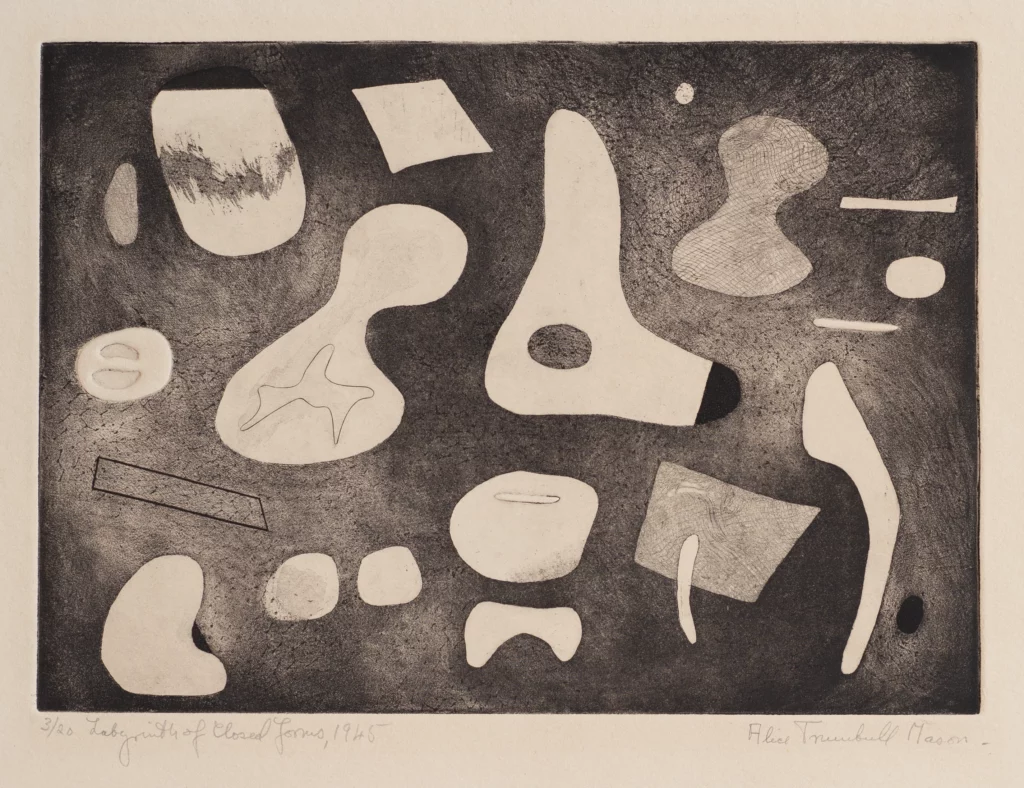
Atelier 17 provided space in which artists could learn, experiment, and exchange ideas in printmaking; particularly, among women. Members of the workshop learned a myriad of printmaking techniques including soft ground etching, engraving, and aquatint. Artists could then work autonomously to experiment and push the boundaries of printmaking within their practice. Atelier 17 operated in New York until the 1950s, and again in Paris until Hayter’s death in 1988.
Letterio Calapai, a fellow member of Atelier 17, loaned Alice Trumbull Mason his Washington hand-style printing press in 1950, which she volunteered to store. Although the press was missing a few components, she was enthusiastic about experimenting with woodcut prints, and was able to reassemble the machine. Over the next decade, Trumbull Mason would create a series utilizing carving tools and the natural wood grain to explore texture, line, and color in printmaking. Her prints are included in numerous museum collections, including The Whitney Museum, The Museum of Modern Art, Brooklyn Museum, and The New York Public Library.